URSA Major Stargate 626 Plugin
When pristine mattered more than character.
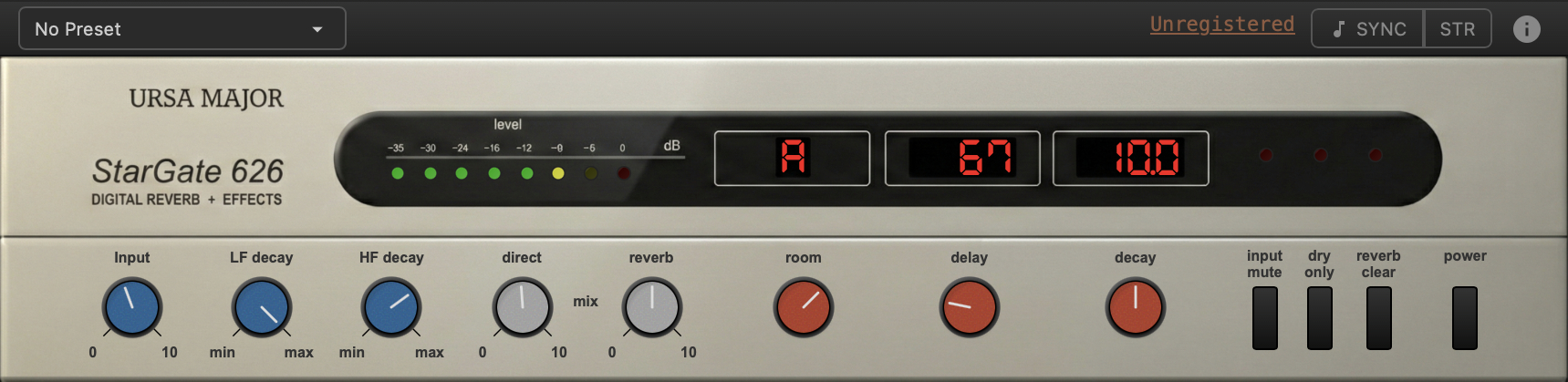
A Cleaner Reverb
After creating the SST-282 Space Station in 1978, Christopher Moore set out to solve what he saw as its flaws (now beloved as its signature character): the spectral smearing, modulation noise, and pitch artifacts caused by its wandering delay taps. The result was the Stargate 626 — double the memory for decay times up to 20 seconds, a completely redesigned reverb algorithm with true pitch stability, wider 15kHz bandwidth, and a smoother, more refined character. This plugin faithfully recreates that classic sound with modern conveniences like tempo sync and preset management.
Demo will output 3 seconds of silence every 30 seconds and cannot save presets. Purchase a license to upgrade the demo to a full copy.
Step Through the Stargate
These samples demonstrate the URSA Major Stargate 626 plugin. Every track plays the Dry (unprocessed) loop first, followed by the Wet (processed) version.
The History of the Stargate

Christopher Moore, founder of Ursa Major and Seven Woods Audio.
When the SST-282 Space Station launched in 1978, it was a revelation—a studio-quality digital reverb at a fraction of the cost of competitors like the EMT 250. But Christopher Moore, its creator, was already thinking about what could be improved. The 282's distinctive character came partly from what Moore considered design compromises: the wandering delay taps that caused pitch artifacts, the spectral smearing from its crude modulation algorithm, and the 7kHz bandwidth limitation imposed by the technology of the day.
By 1984, Moore had developed an entirely new approach. Rather than using simple triangle-wave modulation with complementary tap pairs (the 282's method of minimizing pitch wobble), the Stargate 323 employed PROM-based lookup tables with complex, hand-optimized waveforms. More significantly, the Stargate introduced dual-domain modulation—varying not just the delay time of each tap, but its gain as well. The result was true pitch stability and a smoother, more refined reverb character with a wider 15kHz bandwidth.
The Stargate 323 found its way into studios worldwide, prized for recordings where clarity and pristine character mattered more than the 282's distinctive "grit." The Stargate 626 followed, doubling the memory capacity to allow decay times up to 20 seconds and adding six additional programs. This plugin faithfully recreates that algorithm—the signal-adaptive modulation, the PROM-based waveforms, the refined character—bringing the Stargate's sophisticated reverb to your DAW.
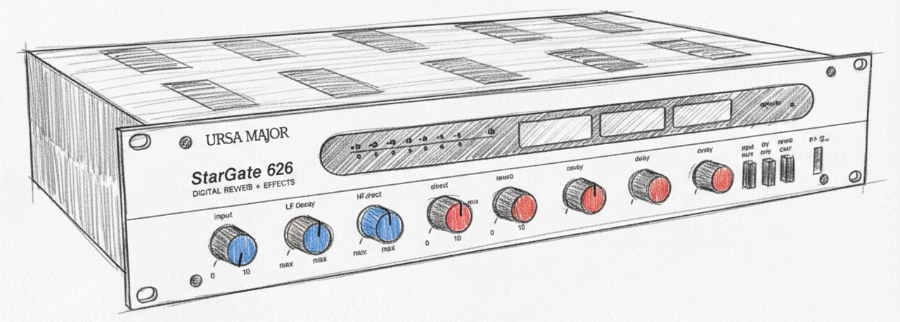
The Stargate 626 expanded on the original 323 with doubled memory for decay times up to 20 seconds.
This Tap Dancer Got New Shoes
SPACE STATION SST-206
DELAY MODULATION
STARGATE 626
RANDOM DELAY + GAIN MODULATION
INPUT LEVEL
50%
SST-206: Complementary Delay Modulation
The Space Station uses 15 feedback taps organized into 7 complementary pairs plus one solo tap. Each pair moves in opposite directions — when one tap shifts forward, its partner shifts back by the same amount. This ingenious design cancels out pitch artifacts while creating the signature dense, shimmering reverb tail. The orb size represents signal level, which remains constant regardless of tap position.
SG-626: Delay + Gain Modulation
The Stargate 626 takes a different approach with its 15 taps. Rather than complementary pairing, each tap modulates independently in both random delay and gain. The ceiling line represents the gain ceiling — a hardware limiter that prevents any tap from exceeding a maximum level. When orbs hit this ceiling, they compress and spark. This creates a smoother, more controlled reverb with less pitch warble but a different character than the Space Station.
© 2026 Temecula DSP.
SST-206 and Stargate 626 are model numbers originally used by Ursa Major and Seven Woods Audio. Temecula DSP is not affiliated with the estate of Christopher Moore, Ursa Major, or Seven Woods Audio.