Temecula DSP DEEP/4 Plugin
A meticulous resurrection of the four-engine legend.
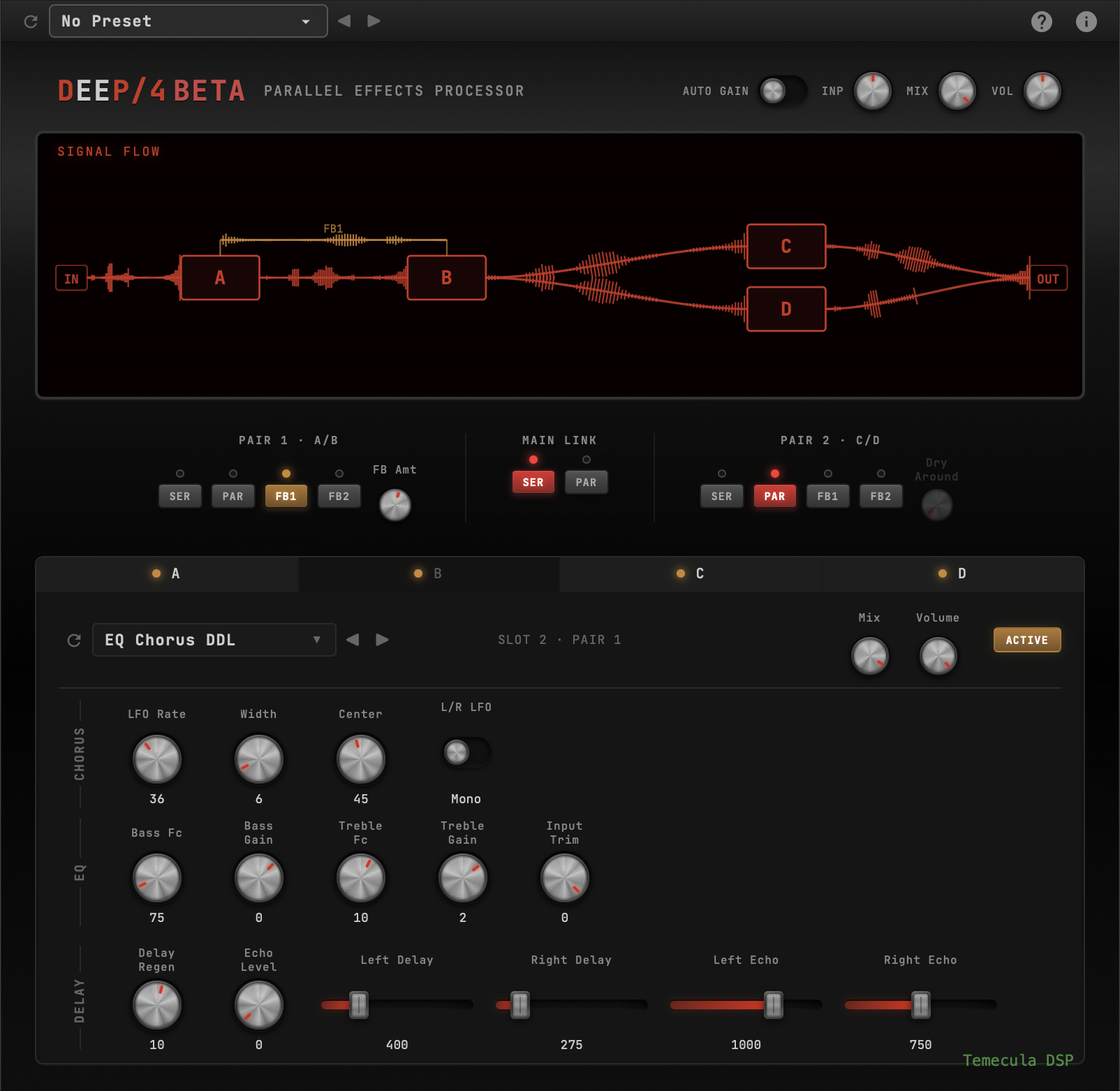
What's Under the Hood
DEEP/4 is a painstaking recreation of one of the most powerful multi-effects processors ever built: The Ensoniq DP/4. Every algorithm has been rebuilt at the lowest level from the original 24-bit DSP hardware.
43 algorithms, mathematically verified against the original DSP architecture. No guesswork.
Import presets directly from the original hardware via SysEx — load classic libraries like Don Solaris' Essentials Vol1 and hear them exactly as they were meant to sound.
VST3
|
AU
|
AAX
Demo will output 3 seconds of silence every 30 seconds and cannot save presets. Purchase a license to upgrade the demo to a full copy.
Let's Go Deep
What Artists Are Saying

"In the short time since his debut with Temecula DSP's amazing SST-206, followed hot on the heels by the equally gorgeous SG-626, John Wheeler has astonished us, yet again with the DEEP/4, his take on Ensoniq's now iconic DP/4 multi-FX processor. Temecula DSP's recreation of this never before emulated classic is instant bliss, as there's no longer any tedious menu-diving. John's willingness to respond quickly and with transparency and clarity to observations and requests has already endeared him to his many users."
Mark Horrocks, Composer/Sound Designer
Features
Four Independent Effects Engines
The DEEP/4 is a powerhouse multi-effects processor featuring 43 fully programmable, high-fidelity algorithms including reverbs, chorus, flanging, delays, distortion, and pitch shifting. Operate it as a single massive effects system, a pair of stereo processors, or four entirely independent units. Its advanced routing matrix supports true serial, parallel, and feedback configurations to sculpt complex effect topologies that conventional units simply can't touch.
Flexible Multi-Unit Routing
Run all four units in series for massive effect chains, split them into parallel paths for layered textures, or use feedback routing to create evolving, self-modulating soundscapes. DEEP/4 provides independent routing control for each pair (A/B and C/D) plus a main bus link — supporting serial, parallel, and two feedback configurations with adjustable feedback amount. Use it as a single 4-unit processor, two independent stereo pairs, or four standalone effects.
43 Algorithms Across 7 Categories
From lush reverbs and complex multi-tap delays to pitch shifters, dynamics processors, and guitar amp simulations — every algorithm from the original hardware is here, rebuilt at the lowest level and fully programmable.
Reverb
Hall
Large Room
Small Room
Large Plate
Small Plate
Reverse Reverb
Gated Reverb
Non-Linear Rev I
Non-Linear Rev II
Non-Linear Rev III
Retrigger Reverse Reverb
Modulation
8-Voice Chorus
Flanger
Phaser + DDL
EQ Chorus + DDL
EQ Flanger + DDL
EQ Tremolo + DDL
EQ Vibrato + DDL
EQ Panner + DDL
EQ DDL with LFO
Rotating Speaker
Delay
Multi-Tap Delay
Dual Delay
Tempo Delay
3.3 Sec Delay
EQ / Filter
Parametric EQ
Vanderpol Filter
Rumble Filter
VCF Distortion
Pitch
Pitch Shifter
Pitch Shift + DDL
Fast Pitch Shift
Amp / Speaker
Guitar Amp I
Guitar Amp II
Guitar Amp III
Speaker Cabinet
Tunable Speaker
Dynamics
EQ Compressor
Expander
Inverse Expander
De-Esser
Ducker / Gate
Keyed Expander
Preset Management
Browse nearly 300 factory presets organized by unit configuration (1U, 2U, 4U) across multiple banks. Save your own custom presets, overwrite them as you refine your sound, and mark any preset — factory or user — as a favorite for instant recall. Step through presets with prev/next navigation for fast auditioning. Load and share presets with the original DP/4 hardware via standard SysEx — import classic preset libraries like the Ensoniq Volume I collection directly into DEEP/4, or export your own creations back to the original unit.
The Story Behind DEEP/4
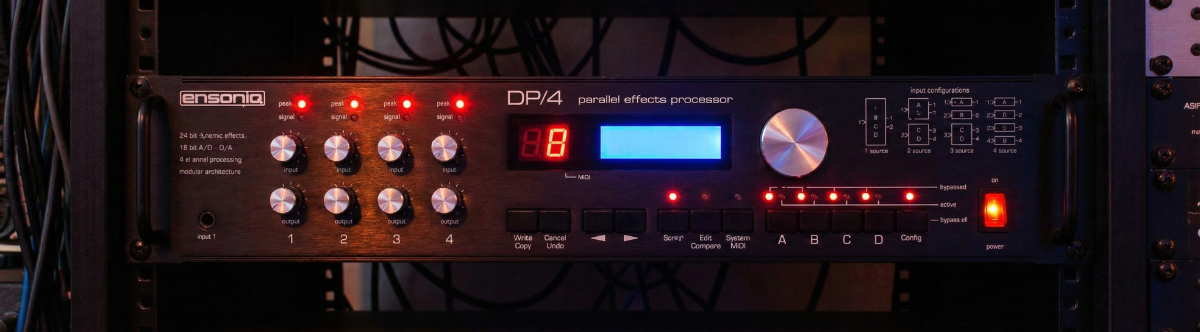
In the early 1990s, a different kind of studio effects unit hit the racks: devices featuring four independent processors that could be combined in serial, parallel, and feedback structures inside a single rack space. Instead of thinking in terms of a single effect block, engineers could build full effect chains in one preset, moving quickly between simple setups and wildly complex structures. The hardware featured over 40 algorithms and nearly 300 presets split across ROM and RAM banks.
Pioneering DSP engineers from that era helped define a workflow that mixed deep routing control with massive algorithm libraries, balancing raw horsepower with fast preset access. That balance became a reference point for effects-heavy production sessions and legendary dance records.
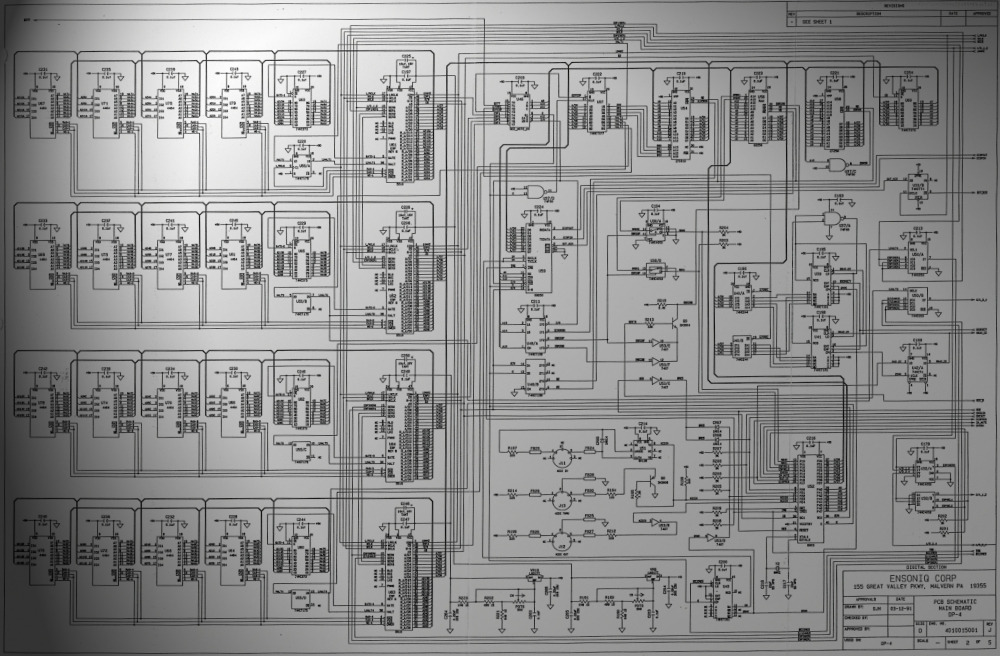
These powerful 4-unit architectures showed up repeatedly in producer conversations from that era onward, especially in electronic music and mix-focused workflows where delay, reverb, and modulation movement are central to the groove.
DEEP/4 is our love letter to that massive, four-unit workflow. We painstakingly recreated the vintage digital character and routing flexibility of the era's most iconic multi-effects hardware, bringing its deeply creative design language into the modern DAW environment.
Interactive Routing Explorer
Understanding This Configuration
Unit A processes the main input and passes it directly into Unit B. The combined output of Pair 1 then flows entirely into Pair 2, resulting in a massive, four-unit deep effects chain. Finally, Unit C feeds directly into Unit D before reaching the master output.
Press
© 2026 Temecula DSP.
SST-282, SST-206 and Stargate 626 are model numbers originally used by Ursa Major and Seven Woods Audio. Temecula DSP is not affiliated with the estate of Christopher Moore, Ursa Major, or Seven Woods Audio.
DP/4 is a trademark of Creative Technology Ltd. Temecula DSP is not affiliated with, endorsed by, or sponsored by Creative Technology Ltd.
"Alesis" and "MidiVerb" are trademarks of inMusic Brands, Inc. Temecula DSP is not affiliated with, endorsed by, or sponsored by inMusic Brands, Inc.